

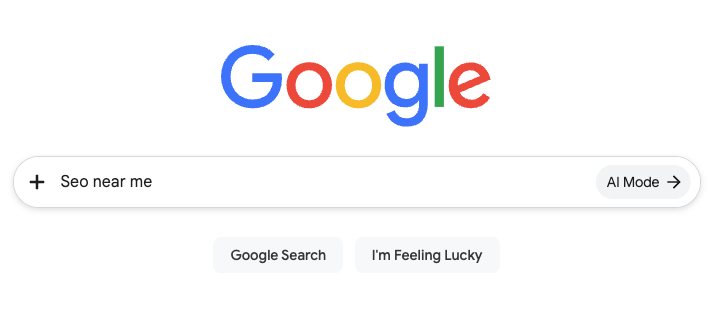
If you have ever typed “SEO near me” into Google, you already understand something most marketing agencies would rather you did not think about too hard: location matters.
You wanted a business you could actually reach, one that understands your area, not a call center that happens to have your ZIP code in a spreadsheet.
So here is the irony.
A huge number of local businesses run that exact search, then end up signing with an agency in another state that has never driven down US-1 in Port St. Lucie, never dealt with a local zoning perk that only someone working in the area would know to ask about, and could not tell Jensen Beach apart from Stuart on a map.
Here’s why locality matters when you pick a search engine optimization specialist near you.
What “seo near me” searches actually tell us about buyer intent
(Source: Google)
Near-me searches are not a minor trend. Close to half of consumers say they “always” or “often” add “near me” to their local search queries, according to BrightLocal’s Local SEO Statistics research. That is not idle curiosity. People search with location built into the query because they want a real, findable answer nearby, not a generic one.
That intent signal matters for how you think about SEO itself. When a Stuart-based dentist searches “SEO near me,” Google is trying to match that query to a genuinely local, relevant result, the same way it would match “dentist near me” for a patient. An agency that treats your business like an interchangeable client in a national portfolio is working against the very intent that got you searching in the first place.
The problem with out-of-state generalist agencies
Generalist agencies scale by templating. One content calendar, one link-building playbook, one Google Business Profile checklist, applied across every client regardless of city. That works fine for industries where geography barely matters. It works poorly for local SEO, where the entire point is standing out in a specific place.
A generalist agency working from Ohio or Texas is not going to know that Port St. Lucie, Stuart, Fort Pierce, and Tradition are functionally different submarkets with different competitive landscapes. These cities have different search volume patterns and different customer expectations, even though they are all within a short drive of each other. They will not know which local publications, chambers of commerce, or community sites are worth a mention and which are dead weight. They will not catch a Google Business Profile category mismatch that is hurting a client’s visibility in a way that would be obvious to anyone who searches that specific market every day.
Why proximity and local knowledge are baked into Google’s algorithm
This is not just a “vibes” argument. Google’s own ranking mechanics reward local specificity. In Whitespark’s 2026 Local Search Ranking Factors report, which surveys 47 local search experts on what actually moves rankings, the primary Google Business Profile category is the single most influential factor for Local Pack and Maps rankings, and proximity, meaning how close a business’s address is to the person searching, ranks second. Whether a business shows as open at the moment someone searches has also emerged as a top-five factor this year.
Every one of those factors depends on granular, local execution. Getting a GBP category exactly right for a chiropractor in Port St. Lucie, for example, is different from getting it right for one in Stuart, because the competitive set Google is comparing them against is different. An agency that is not paying close attention to that specific competitive set is optimizing blind.
Reviews, reputation, and why local context still matters
Reviews are not a “nice to have” bolted onto SEO. According to BrightLocal’s Local Consumer Review Survey 2026, 97% of consumers read reviews before choosing a local business, and 41% now say they “always” read reviews when browsing, up sharply from 29% the year before. Star rating expectations have also tightened; more consumers than ever will only consider businesses rated 4.5 stars or higher.
Responding to reviews well, catching a fake or unfair review before it does damage, and knowing which review platforms actually matter in your specific market all require someone paying attention to your business specifically, not running an automated response script across two hundred accounts. That is a local-agency strength, not a national-agency one.
What answer engine optimization means for Treasure Coast businesses
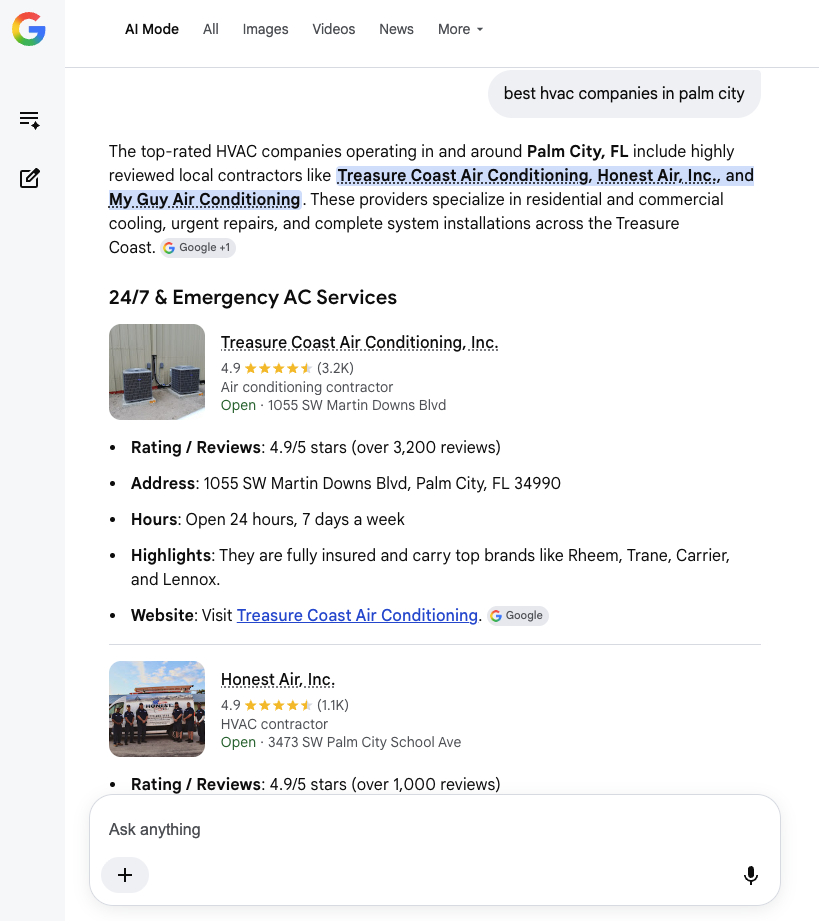
The same BrightLocal survey found something that should get every local business owner’s attention: AI tools like ChatGPT jumped from just 6% to 45% usage for local business recommendations in a single year, while Google’s share of local discovery slipped from 83% to 71% over the same period. Customers are starting to ask AI assistants who the best HVAC company or dental practice in their area is, instead of typing it into a search bar themselves.
Here is an example of someone searching for HVAC companies in Palm City with Google’s AI Mode.
(Source: Google)
That shift is what answer engine optimization (AEO) is built to address, and it is a good example of why local expertise compounds. Getting cited correctly by an AI answer engine depends on the same fundamentals: accurate, consistent business information, strong review signals, and locally relevant content that actually reflects how people in your market search and talk. A generalist agency running the same AEO playbook nationwide is not tuning any of that to your specific Treasure Coast market. A local agency that already understands the on-the-ground competitive landscape has a real head start.
How to tell if an “seo near me” agency is actually local
A few questions cut through the marketing copy fast:
- Can they name your direct local competitors without you telling them first?
- Do they know the practical difference between marketing to Port St. Lucie and marketing to Fort Pierce?
- Is their case study evidence from businesses in your actual region, not just your industry nationwide?
- Will you ever talk to the person doing the work, or only an account manager relaying updates from another state?
- Do they treat your Google Business Profile category and proximity signals as a strategic decision, or a box they check once and forget?
If the honest answer to most of these is no, “local” is a label, not a service model.
Ready to work with an agency that actually knows the Treasure Coast?

PeakHippo is based right here, serving Port St. Lucie, Stuart, Jensen Beach, Fort Pierce, and Tradition. We are not a national call center running the same playbook in every zip code. We know this market because we work in it every day.
If you want to see what a local SEO agency built for your area can actually do, get in touch with PeakHippo for a conversation about your business, not a generic pitch.
FAQs
Below are some common questions about choosing an SEO agency near you.
Does hiring a local SEO agency actually help my Google rankings, or is it just a nice idea?
It helps in a measurable way. Proximity and Google Business Profile accuracy are established ranking factors, not soft benefits. An agency working closely in your specific market is better positioned to get those details right than one applying a national template.
What is the difference between local SEO and answer engine optimization (AEO)?
Local SEO focuses on ranking in traditional Google results and the Local Pack. AEO focuses on being the answer AI tools like ChatGPT or Google’s AI features give when someone asks for a recommendation. They share a foundation, accurate business information and strong reviews, but AEO is increasingly its own discipline as more consumers ask AI directly instead of searching.
How do I know if my current SEO agency actually understands my local market?
Ask them to name your top three direct competitors without prompting, and ask what specifically they have changed about your strategy based on your city versus a neighboring one. Vague answers are a warning sign.
Is a local agency more expensive than a national one?
Not necessarily. Pricing depends on scope of services and the agency’s overhead, not simply geography. The bigger cost difference usually shows up in wasted spend, a generic strategy that does not fit your specific market tends to produce weaker results for the same budget.
My business is in a smaller town like Jensen Beach or Tradition. Does local SEO still matter for me?
Yes, often more than for a business in a larger city. Smaller submarkets typically have less competition online, which means a well-executed local SEO strategy can produce outsized visibility gains faster than in a saturated market.