
If you run an HVAC company on the Treasure Coast, your phone rings because someone searched for you first. When an AC unit dies in July, the homeowner pulls out their phone and searches “AC repair near me” or “emergency HVAC repair Port St. Lucie.” That makes local search visibility one of the highest-leverage investments an HVAC business can make. Here’s what actually moves the needle for HVAC companies serving Port St. Lucie, Tradition, Jensen Beach, Stuart, and Fort Pierce.
Your primary GBP category is doing more work than you think
Google Business Profile category consistently ranks as the single most influential Local Pack ranking factor. For HVAC companies, this matters because Google gives you options: HVAC contractor, Air conditioning contractor, Heating contractor, and several more.
The mistake most owners make is picking the broadest option and stopping there. BrightLocal’s own GBP category study found that businesses using around four well-chosen additional categories achieve the strongest average map rankings. The better move is picking the primary category that matches the job type you most want to book (installation vs. repair, for instance), then layering in closely related secondary categories so you still show up for adjacent searches.
The HVAC SEO keywords that drive calls
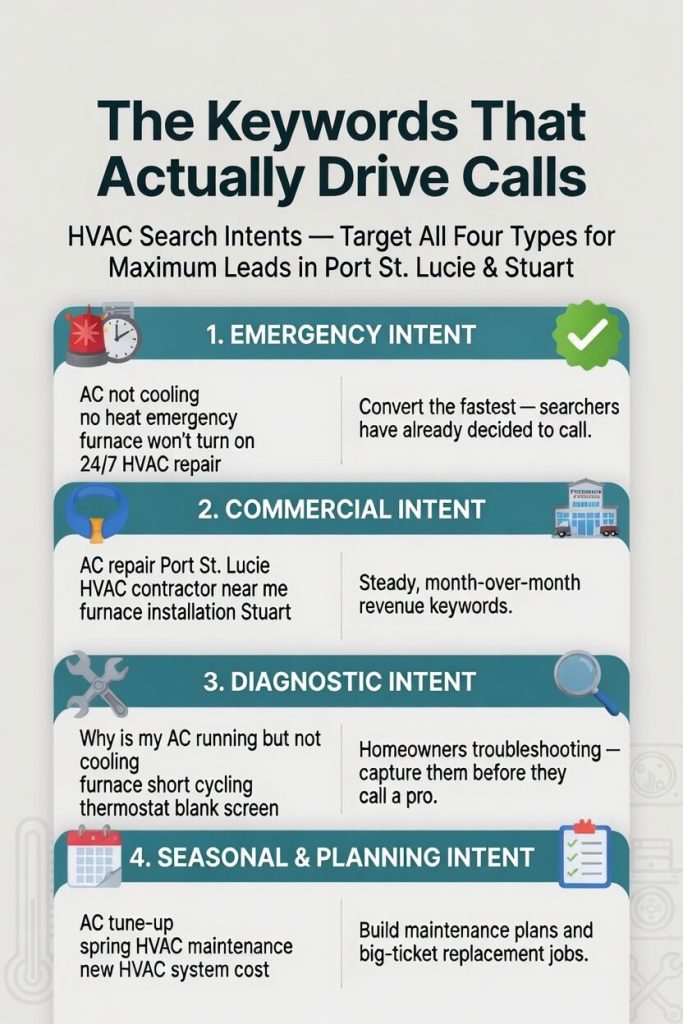
HVAC search splits into a few distinct intent types, and a real local SEO strategy targets all of them, not just the obvious one:
- Emergency intent: “AC not cooling,” “no heat emergency,” “furnace won’t turn on,” “24/7 HVAC repair.” These searchers have already decided to call someone. They convert the fastest.
- Commercial intent: “AC repair Port St. Lucie,” “HVAC contractor near me,” “furnace installation Stuart.” These are the steady, month-over-month money keywords.
- Diagnostic intent: “Why is my AC running but not cooling,” “furnace short cycling,” “thermostat blank screen.” These are homeowners troubleshooting before they decide whether to call a pro, and they matter more than most HVAC companies realize (more on that below).
- Seasonal and planning intent: “AC tune-up,” “spring HVAC maintenance checklist,” “new HVAC system cost.” Lower urgency, but valuable for maintenance plans and bigger-ticket replacement jobs.
Each city you serve needs its own page built around these intents with real local detail, not the same page with the city name swapped out.
How homeowners troubleshoot with AI before they call
This is the part most HVAC companies are missing entirely. Per BrightLocal’s Local SEO statistics, 45% of consumers now use ChatGPT or similar generative AI tools for local business recommendations. When someone’s AC starts short-cycling or blowing warm air, a growing share of them are asking an AI assistant what’s wrong before they ever pick up the phone.
Here’s the part that matters for your business: being recommended by AI is a different, harder game than ranking in Google. Google and AI platforms are no longer working from the same playbook.
What this means practically: if your website has clear, well-structured content answering the diagnostic questions homeowners actually ask (“why is my AC running but not cooling,” “what does a blinking furnace light mean”), you become a source the AI can cite when it explains the problem. And when the AI’s advice runs out and the homeowner needs an actual technician, the business that already showed up as the trustworthy authority on the problem has a real edge over one that never appeared in the conversation at all.
Structured content, accurate GBP data, and consistent citations aren’t just ranking factors anymore; they’re what AI systems check before they’ll confidently recommend you.
Organic beats paid on cost per lead, once it’s built
This is the number that should change how you think about your marketing budget. Per SearchLight Digital’s January 2026 benchmark, tracking $14.9 million in Google Ads spend across 816 HVAC and plumbing contractors, the blended cost per lead is $104, with non-branded search (the campaigns that actually find new customers, not people already searching your business name) running $149 per lead.
Paid ads buy speed. The moment you stop paying, the calls stop, and that per-click cost never goes away. Organic rankings work differently: there’s no per-click toll once a page ranks, and the leads that come from it aren’t handed to three competitors bidding on the same term at the same time. SEO takes longer to show results, but it’s the only channel building an asset instead of renting attention.
HVAC is a mobile business before it’s anything else
You may have an admin office, but that’s not where your business actually happens. Your technicians are in trucks, at customers’ homes, all day. The “office” that matters most to a homeowner deciding who to call isn’t a building but search results. Your office is online.
That changes what “having a strong local presence” should mean for an HVAC company.
Your Google Business Profile, not a physical storefront, is the first impression. Your site needs to load fast and show a phone number a thumb can tap without hunting, because the person looking is often standing in a hot house right now, not browsing casually at a desk.
Treat your online presence as the real office, the one that’s actually open and staffed 24/7 whether or not anyone answers the shop phone after 5pm, because for a growing share of your customers, it’s the only “location” of your business they’ll ever interact with before they decide to call.
Where PeakHippo fits in for HVAC SEO
HVAC is one of the highest-value local SEO investments a business can make, because a single booked replacement job easily covers months of the marketing spend that got you found in the first place. The businesses winning the map pack, and increasingly the AI recommendation, in 2026 aren’t necessarily the biggest; they’re the ones treating their Google Business Profile and website as a living, mobile-first storefront instead of a one-time setup task.
That’s the exact work PeakHippo does for HVAC companies on the Treasure Coast: GBP optimization, review systems, city-specific content, and the AEO groundwork that gets you cited by AI, not just ranked by Google.
Want a free audit of where your HVAC company currently stands in Port St. Lucie local search? Reach out to PeakHippo for a no-obligation look at your GBP, citations, and map pack visibility.
FAQs for HVAC SEO in PSL
Here are common questions about HVAC SEO best practices in the Treasure Coast.
How much should our HVAC company budget for local SEO?
Industry benchmarks put HVAC SEO between $700 and $8,000 per month, with most mid-size contractors landing between $1,500 and $3,600 monthly for consistent growth. A single-location contractor in a low-competition market can often start toward the lower end.
How long until we see results?
Most HVAC companies see initial ranking movement within 60 to 90 days, with more competitive markets taking up to 6 months. Meaningful lead volume typically follows a few months after that. It’s a slower start than paid ads, but the results compound instead of disappearing when spend stops.
We’re already running Google Ads. Do we still need SEO?
Yes, and the two work best together. Google Ads gets you leads immediately, but non-branded search ads are pricey, and you stop seeing results the minute you stop paying — with no ceiling. Organic rankings take longer to build but don’t carry a per-lead toll once they’re in place, which is why most successful contractors run both in parallel rather than picking one.
Do we need a separate page for every city we serve?
Yes, but only if each page has real, distinct local detail. A single page with the city name swapped out doesn’t perform the same way as pages built around what actually differs by service area (response times, specific neighborhoods, local weather patterns affecting HVAC use).
How many Google reviews do we actually need?
There’s no longer a hard threshold. BrightLocal’s 2026 Local Consumer Review Survey found consumers are increasingly comfortable choosing businesses with fewer total reviews than they expected a couple of years ago. What matters more is consistency: recent reviews, a real response rate, and steady volume over time, not a single high number you hit once and stop.
Should we care about showing up in ChatGPT or AI search, or just Google?
Both, and increasingly they require different work. Per BrightLocal’s Local SEO statistics, less than half of businesses that lead Google’s local results also appear in AI-generated recommendations. Ranking well in Google’s map pack no longer guarantees you’ll be the business an AI assistant recommends when a homeowner asks it for help.